


QUANDO CORRERE
Quando correre sul Carso — perché gennaio
Vegetazione spoglia, aria tersa, clima mite: la finestra invernale che apre il Carso allo sguardo.
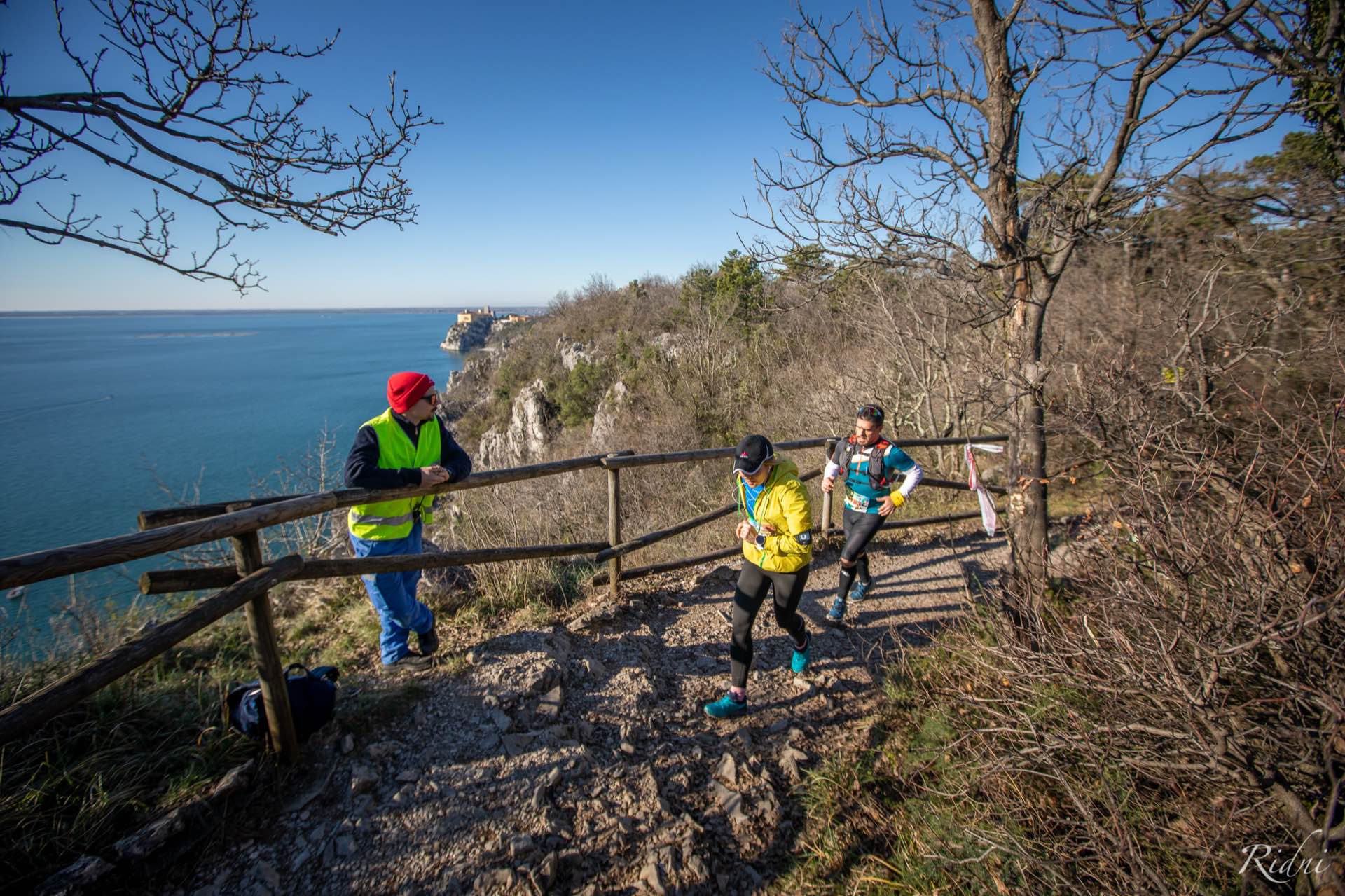
Chi cammina o corre sul Carso in piena estate, tra la macchia mediterranea rigogliosa, spesso non si accorge di quanto il ciglione carsico sia vicino al mare. A gennaio è tutta un’altra storia: the trees are bare, the low vegetation retreats, and from many stretches of the trail the Gulf of Trieste suddenly opens up, the white cliffs, and on the clearest days even Istria and the snow-covered Julian Alps on the horizon. It is the same view that opens up on the ridge sections of Monte Ermada, along the S1 Half Trail, where the bora blows freely and the view sweeps from the Julian Alps to Istria.
Perché il Carso si corre a gennaio
Il Carso triestino è un altopiano calcareo coperto in gran parte da bosco ceduo misto (roverella, carpino nero, orniello) e da lande carsiche con macchia mediterranea nelle doline più riparate. Da primavera a autunno questa vegetazione è in foglia piena: richiude i sentieri in un corridoio verde e nasconde gran parte delle vedute sul mare e sulle valli, che si aprono solo nei punti più esposti (ciglioni, cave, radure). In inverno la situazione si ribalta: gli alberi decidui perdono le foglie, la vegetazione bassa si assopisce, e i punti panoramici — quelli che d’estate sono aperture isolate — diventano la norma per lunghi tratti di sentiero.
È lo stesso motivo per cui i punti più fotografati e raccontati della Corsa della Bora sono tratti di cresta esposti: il ciglione sopra PortoPiccolo e le Falesie Bianche, il Sentiero Rilke tra Sistiana e Duino, l’anello del Monte Ermada, il tratto alto sopra la Costa dei Barbari. Sono luoghi che d’estate si attraversano dentro un tunnel di vegetazione; a gennaio si attraversano guardandoli.
Il clima del Carso in inverno
L’altra metà della risposta è climatica. Il Carso di Trieste ha un inverno relativamente mite per la sua latitudine, per l’influenza del mare Adriatico: temperature diurne che restano spesso sopra lo zero, giornate di sole frequenti, nessuna neve stabile alle quote dei percorsi di gara (che restano sotto i 500 m). Non è un’impresa artica: è un inverno mediterraneo, corribile.
Il fattore che cambia davvero le carte è la Bora: il vento catabatico che dà il nome alla gara soffia soprattutto in questa stagione (approfondimento sulla pagina dedicata) e, quando c’è, spazza l’aria da polvere e foschia — è il motivo per cui i punti panoramici da cresta risultano più nitidi proprio nei giorni di bora, non nonostante il vento ma grazie ad esso. Il weekend di gara, sempre a gennaio, si è diviso storicamente quasi a metà tra bora e scirocco (il vento umido da sud-est): non è garantito che ci sia bora ogni anno, ma la finestra invernale è quella strutturalmente più esposta al fenomeno che rende l’aria del Carso più trasparente.
E nelle altre stagioni?
Primavera e autunno sul Carso sono piacevoli — temperature miti, fioriture in primavera, colori caldi in autunno — ma la vegetazione è già in gran parte tornata a coprire i sentieri, e le viste aperte restano limitate ai punti più esposti. L’estate è calda e afosa, con la macchia mediterranea al culmine del suo sviluppo: bella da vivere nelle giornate di mare, meno per la resa panoramica in quota, dove il verde fitto richiude gran parte degli scorci.
Nessuna di queste stagioni è “sbagliata” per camminare o correre sul Carso. Ma solo gennaio unisce le tre condizioni insieme — vegetazione spoglia, aria tersa (quando soffia la bora), clima ancora corribile — che aprono davvero il paesaggio allo sguardo. È una finestra stretta, e la Corsa della Bora è nata proprio dentro quella finestra.
L’evento della finestra invernale: la Corsa della Bora
La Corsa della Bora si corre ogni anno a gennaio tra il Carso italiano e quello sloveno, con partenza e arrivo tra Trieste centro e PortoPiccolo (Sistiana). L’edizione 2027 si corre il 9-10 January 2027 ed è la 12ª edizione della manifestazione (11 edizioni già completate dal 2016 al 2026), con 70 nazioni rappresentate e circa 3,300 participants nell’edizione più recente.
Sette distanze, ognuna un modo diverso di attraversare la stessa finestra invernale:
| Distance | Link |
|---|---|
| S1 Borin 4 km | s1trail.com/borin |
| S1 Family Hike & Trail 14.5 km | s1trail.com/s1-family-hike-2 |
| S1 Half Trail 23 km | s1trail.com/s1-half |
| S1 Borderless Trail 36 km | s1trail.com/s1-borderless-trail |
| S1 TransKarst Ultra 55 km | s1trail.com/s1-trail |
| S1 Trieste Ultra 61 km | s1trail.com/s1-bora-ultra |
| S1 Bora Ultra 116 km | s1trail.com/s1-bora-ultra-116-km |
Dai 4 ai 116 km, sette modi di essere in gara nella stessa finestra di gennaio — dal passo in famiglia della S1 Borin alla notte intera della S1 Bora Ultra. Il quadro completo di iscritti, cancelli e certificazioni ITRA/UTMB Index per ogni distanza è sulla pagina Official Data La Corsa della Bora 2027; per iscriversi, la pagina Registration.
Scopri il territorio in questa stagione
Le viste aperte di gennaio raccontate qui sopra si trovano concretamente lungo il percorso — e vale la pena visitarle anche fuori gara, in questa stessa finestra invernale:
- Duino and the Rilke Path — il tratto panoramico per eccellenza tra le falesie, con vista sul Golfo di Trieste
- Costa dei Barbari — il litorale selvaggio incuneato tra le falesie bianche del Carso
- The Bora, the wind that gives the race its name — perché il vento invernale rende l’aria del Carso così nitida
- Trail running in Trieste and the Karst — l’hub con tutti i sentieri della zona (Alta Via del Carso, Sentiero Rilke, Val Rosandra, Napoleonica, Sentiero della Salvia)