


S1 Borderless Trail 36 km


New for 2027! A brand-new course!
The Borderless Trail is the right choice if you want a race with real character and a border-country feel that sets it apart from the usual loop races. It suits runners who love variety and courses that keep changing pace and atmosphere: not an extreme ultra, but still a serious, memorable test. It is a race that leaves you feeling you have truly moved through a place, not just through a distance.
📍 Logistics
🧳 Bag storage
🚧 Time barriers, refreshment points and checkpoints
- 🥤🍴 ⏱️ Medeazza, km 10.1
- 🥤🍴 ⏱️🚧 San Pelagio, km 21.7 13.15
- 🥤🍴 ⏱️🚧 Santa Croce, km 27.4 14.15
🎒 Mandatory kit
- Enough food and water to run 10 km
- Your own cup or mug for drinking at the refreshment points
- Head torch
- Long trousers and a long-sleeved top, or any combination that fully covers arms and legs when needed
- Survival blanket (emergency foil blanket)
- Gloves, hat and windproof jacket
- Mobile phone
🚌 Shuttles
💶 Entry fees
- €36 up to and including 1 June
- €40 up to and including 1 September
- €55 up to and including 1 November
- €60 up to and including 15 December
- €75 up to and including 10 January
🏅 Awards
Not ready to sign up yet?
If now’s not the moment, let’s stay in touch — we’ll keep you posted on race news. One email a month, at most.
Course and elevation profile
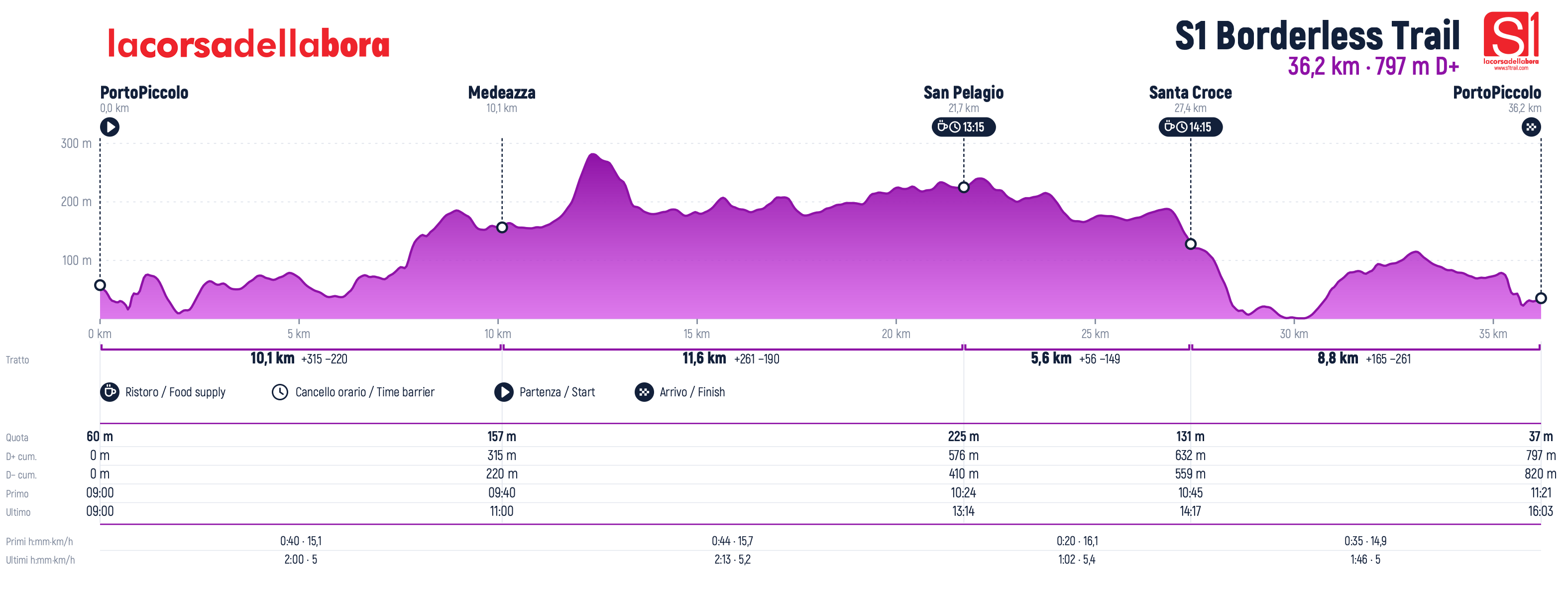
Time barriers and refreshment points
Can’t find the GPS track?
Everything you need to prepare for the race is already on this page: the map, with the ITRA-certified distance and elevation gain, and the point-by-point checkpoint table, showing the kilometre mark, the ascent and descent of each section, the refreshment points and, where there are any, the time barriers and their closing times. These are the official race figures — the ones that count under the regulations and for ITRA points — and they are final: with that table you can plan your pacing, your split times, what to carry and where to refuel.
We hold the GPX back for two reasons, and neither is an oversight.
The first is your safety. People who download the track weeks in advance don’t go back and check it, and in exceptional cases the course can change at the last minute: a road closed, a path no longer passable, extreme weather. Set off with an old track on your device and you’ll find yourself following a line that no longer exists — and that’s where the risk becomes very real.
The second is that some sections cross private land. They are open for the race under agreements made for that day: they aren’t routes you can go out and do whenever you like.
Holding the track back for now isn’t a shortcoming: it’s how we make sure you have the right course on race day. The official GPX is released in the week before the race, in its final version, ready for you to load onto your device. On the day, the course is marked in any case: GPS is an extra check, not what you navigate by.
We often publish training loops and segments covering the stretches that are open all year round, so you can get to know the terrain before the race.
In the meantime, we recommend:
- looking at previous years’ tracks online, which help you get to know the terrain — though the course changes from year to year and some sections are only open on race day;
- consulting the interactive map to plan your recces;
- checking our Facebook page and the articles on the site for updates and recce loops.
CAI trail network
This course takes in CAI trails on the Karst
The race alternates trails listed in the CAI FVG trail register — Sector 0, Karst — with connecting sections specific to the course, waymarked by the organisers.
- CAI 001
- CAI 001a · Sentiero del Mitreo
- CAI 033
- CAI 003a
- CAI 003 · Alta Via del Carso
- CAI 032
- CAI 010
- CAI 035
- CAI 023 · Tiziana Weiss
The course
The start at the Bora Village takes your breath away: the Adriatic all around, white cliffs above the bay. A fast start on the road up to the Sentiero Rilke, then you settle into your stride along the cliffs, pass through Duino beneath the castle, and then the Karst opens up before you.
The heart of the race is the Monte Ermada ridge, the cross-border section where the landscape is still that of the First World War: summits, dolines and caves converted into military shelters. Beyond the Grotta del Motore you head east on a route of your own, between the Grotta Dörfler and Monte Sambuco, before rejoining the longer races and heading back to the sea via San Pelagio, the Lupinc Park and Santa Croce.
It is a race with real character and a border-country feel that sets it apart from the usual loop races.
Who this race is for
The S1 Borderless Trail is a course that keeps changing pace and atmosphere, with the cross-border Monte Ermada section, between Medeazza and San Pelagio, at its heart. It is a serious, memorable challenge, not an extreme ultra.
Medical certificate. Mandatory: a valid certificate of fitness for competitive sport (athletics, cross-country skiing, triathlon, cycling or swimming). Competitors who are not Italian citizens and are not members of an Italian sports club recognised by CONI are exempt.
The right pace. At a brisk walking pace (around 5 km/h), covering the 36.2 km takes about 7 h 14 min: pure fast hiking puts you right on the limit of the maximum time of 7 hours 10 minutes and only works if you keep up a strong pace on the runnable sections and get through the intermediate time barriers in time. The final section (Santa Croce–finish) is the fastest of the whole course and lets you make up time.
Dogs. Not allowed: the S1 Borderless Trail is a competitive race.
Sister races: the 30–36 km band. In terms of physical demands, the S1 Borderless Trail sits in the 30–36 km band of our family of events, where its direct sister is the Jôf Trail (30.5 km) at the Alpe Adria Ultra Trail, Summer edition. No Sardon Run race falls into this particular band.
Want to train on the S1 Borderless Trail paths outside the race weekend too? The guide Trail Running in Trieste brings together Karst routes you can run or walk all year round.

In Trieste, you never know.
One year in short sleeves drinking beer by the sea after the race. The next year, wrapped up to the eyeballs. The weather changes; the fun doesn’t. Check 10 editions’ worth of stats, then decide at the last minute what to wear.
Gallery


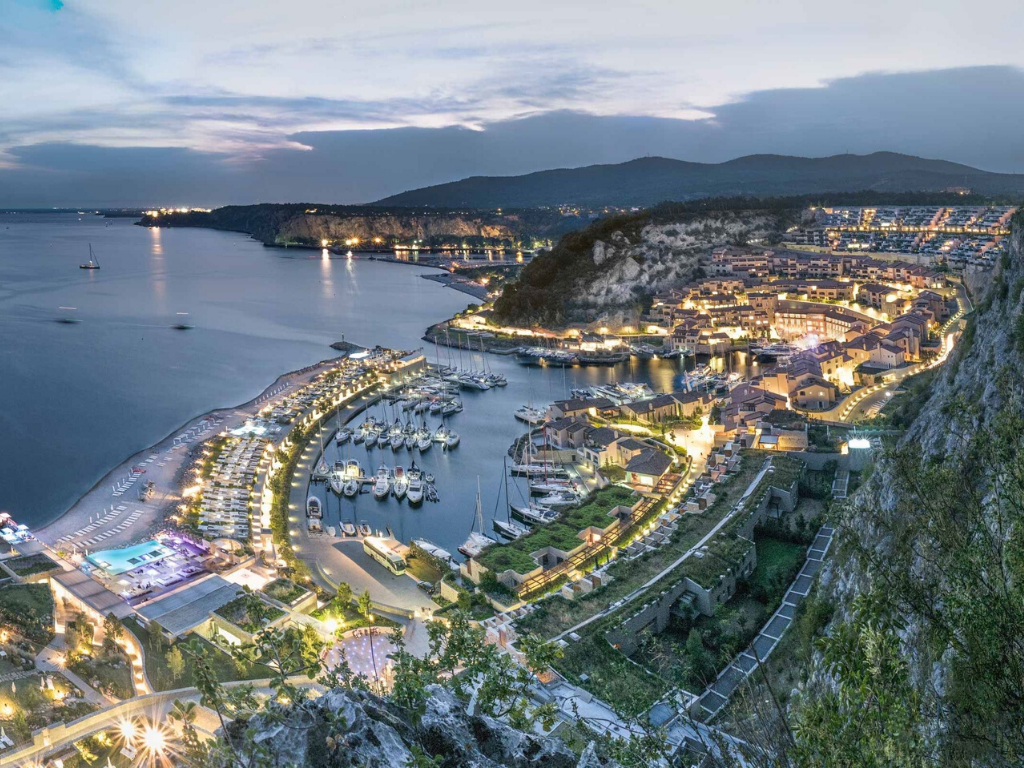
PortoPiccolo — Bora Village
Start and finish for almost every race. The Bora Village at PortoPiccolo is the event’s base: a fully covered, heated venue overlooking the Gulf of Trieste, with everything you need before, during and after the race.
One place for bibs, expo, showers, food and prize-giving — no moving from place to place, nothing spread out. Arrive, run, celebrate.
Accommodation
Apartment or hotel: book it yourself or straight from your Runner Profile. At the Corsa della Bora you can share an apartment with other runners — we’ll take care of matching you up with flatmates.
PortoPiccolo and Sistiana have places to stay just a short walk from the start. Trieste is 20 minutes away by bus.
Shuttles
Dedicated shuttles run from Trieste Central Station to the Bora Village and back: the outward trip costs €4 and the return is free. Each distance has its own timetable — check the page for your race.
The Bora Village is also on the regular Airport–Trieste bus route, so you can get there by public transport without the shuttle.
Getting to Trieste
The Bora Village is ideally located: two minutes from the motorway exit, 15 minutes from Trieste Central Station and 20 minutes from Friuli Venezia Giulia Airport.
By car, train, bus or plane — Trieste is closer than you think. It’s 90 minutes from Ljubljana and less than two hours from Venice.
PortoPiccolo, Sistiana · Duino-Aurisina (TS) · 2 min from the A4 motorway · 45.7633° N, 13.6350° E
🩺 Medical certificate: competitive and non-competitive races
✅ No medical certificate needed
🚧 Medical certificate required
- NOT an Italian citizen and
- NOT a member of an Italian sports club recognised by CONI