



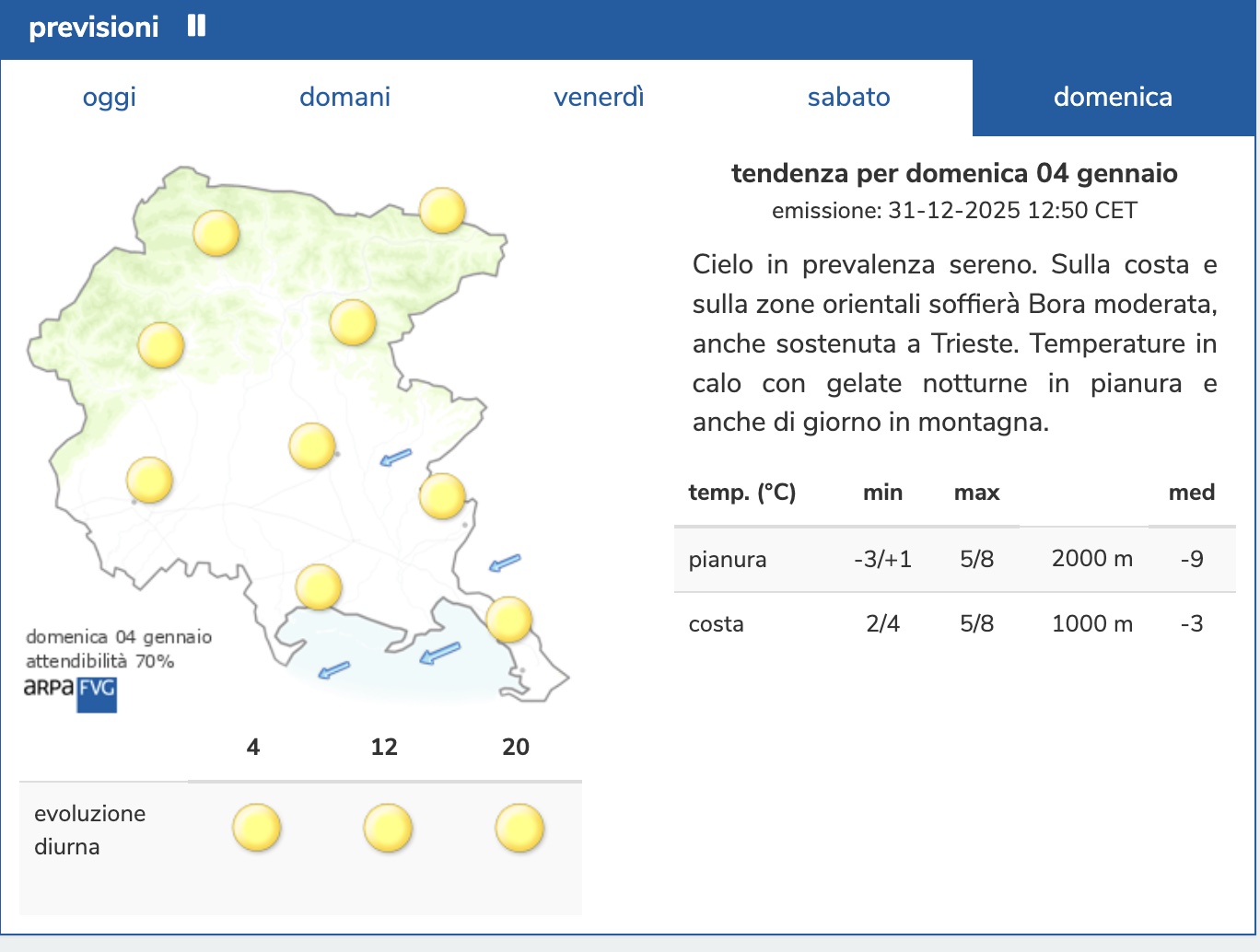
The latest analysis of intermediate model calculations ECMWF and GFS, crossed with high-resolution projections ICON, confirm that the initially predicted disturbance has been pushed back southwards. This scenario opens the door to the so-called “Bora Chiara”A meteorological event characterised by clear skies, exceptional visibility and an influx of arctic-continental air from the Balkans. It will not be a race against the mud, but an endurance challenge against the frost and the dry windwith temperature excursions which will require meticulous energy and clothing management.
The territory of the Karst will present two opposite worlds in the space of a few kilometres. At sinkholes and in the inland basins we will see a very strong thermal inversion: overnight, frosty air will be trapped at the bottom, bringing actual temperatures down to -8°C and making the ground hard as concrete. On the contrary, along coastal stretches and in cities, solar radiation may create some “oasis” sheltered from the wind with perceived temperatures up to +10°C. This temperature change of almost twenty degrees is the number one danger for the emergence of cramps and for the management of body heat. From a physiological point of view, remember that the Dry Bora accelerates the invisible dehydrationsweat evaporates instantly and the feeling of thirst disappears, but the body continues to lose fluid and burn glycogen much faster to maintain the internal temperature. It is vital drinking and feeding regularly even in the absence of stimuli.
For those who will face the overnight departures, the frost will also be a challenge for technology: we recommend keeping the mobile phones and the replacement batteries in contact with the body, as extreme cold can halve the charge of lithium batteries in less than an hour. For those leaving in the morning, the priority will be the dynamic stratification. The most common mistake is dressing too much for the perceived cold at the start line; it is better to start slightly “underclothes” knowing that the body will warm up in a few minutes, while maintaining the gloves and the shell at hand for sudden entry into the shaded areas of the sinkholes where the night frost will still be active.
Based on these technical considerations, we ask you to pay close attention to the following material and safety advice:
- Mandatory shell: a high quality windstopper as a priority.
- Skin protection: barrier creams or Vaseline on cheekbones and lips to prevent cold injuries.
- Breathing: neck warmer to filter the icy air and protect the bronchi.
- Socks: thermal, protecting the Achilles tendons, which are particularly vulnerable to low temperatures.
- Technology: phones and powerbanks in contact with the body (cold = battery collapsing).
Stay tuned for the final bulletin which we will release tomorrow afternoon, 1 January. On that occasion we will analyse data from high-resolution models ALADIN-SI and MOLOCH, which will provide us with the precise mapping of the gusts of Bora and the hourly temperature tables for each sector of the course. The challenge is set: it will be a day of rare beauty, clear and brutal, to be addressed with the head even before the legs.
First (fundamental) thing: read the Race Guide (Roadbook)
It is the official reference for logistics, safety, rules and operational guidance.
Open Race Guide → https://www.s1trail.com/rb/